
Jane Austen's "Persuasion": Let the Read-Along Begin
And we're off!

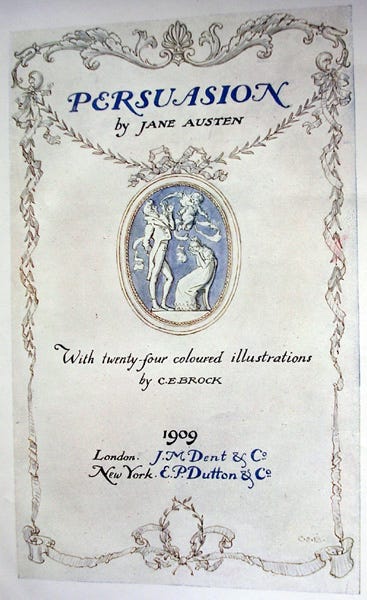

As promised, today is the day we begin reading Jane Austen’s last novel, Persuasion, winner of the 2026 Literary March Madness competition at From My Bookshelf.
I’m excited to be doing this read-along together with my colleage Christina Bieber Lake of Art & Soul. We’ll be sharing the duties, cross-posting to each other’s Substacks, and teaming up for some live conversations over the next month and a half.
In today’s post, I’ll offer a brief introduction to the novel, say a bit about its themes, and comment on its opening chapter. And, in general, try to get as many of you as possible excited about reading along with us! This will also set the table for our next round of commentary, halfway through Volume I, when either Christina or I—we haven’t divvied up that responsibility yet—will cover the first quarter of the novel and set the table for our Substack Live conversation on Wednesday, July 1.
A couple of weeks ago, Christina and I were discussing the read-along, trying to nail down some details. She asked me, “Why are you excited about reading Persuasion?”
The question took me aback for a moment. To be honest, I had never even thought about it. After all, I had promised to read whichever novel won my March Madness competition. Persuasion won. So I was going to read it. It didn’t really matter whether I was excited about it or not.
But, in fact, I am excited about it. I think of Austen as one of my favorite novelists, but that judgement by now rests upon pretty ancient experience. It’s been ages since I read any Austen. It’s well past time to test whether a re-reading confirms my old favorable opinion.
There’s more than that, however. My training is not as a literary scholar but as a political theorist. And Jane Austen is an ideal novelist for a political theorist to study. She is a remarkably careful, subtle, and astute observer of social manners and mores. Even when she is not overtly political, she is concerned with social class, hierarchy, the decline of the aristocracy and rise of commerce, property, relations between men and women, and the dialectic of nature and convention. She chronicles the rise of a middle-class society in which characters not unlike ourselves worry about status, connections, influence, recognition, prosperity, happiness, and love.
In her introduction to the Penguin Classics edition of Persuasion, which Christina and I are using as our common text (though any edition will do if you want to read along), Gillian Beer highlights the novel’s philosophical dimension. “Three of Jane Austen’s novels,” she writes,
set up intellectual and moral debate in their titles: two of them are Sense and Sensibility and Pride and Prejudice. The third is Persuasion…. Whereas the earlier novels polarize qualities (sense and sensibility) or set them in awkward juxtaposition (pride and prejudice), Persuasion compresses all the debates within one term.
Persuasion, she goes on to say, “is the aim of all rhetoric.” It aims at motivating people to believe certain things or take certain actions—ideally for their good, or the common good, although we know that rhetoric can also persuade people in dangerous directions. Beer emphasizes that all attempts at persuasion are morally fraught, because through them we attempt to steer someone toward a possible alternative future that might prove harmful, even if we have the best of intentions.
We learn of a failed attempt at persuasion in the novel’s very first chapter. Sir Walter Elliot and his oldest daughter, Elizabeth—both of them vain and foolish—hope to entice William Elliot, Elizabeth’s cousin and heir to the Elliot estate, into marrying her. This would ensure that the estate remains in Walter’s direct line, since he has no son of his own. Sir Walter seeks out the young man’s acquaintance, “and though his overtures had not been met with any warmth, he had persevered in seeking it.” For her part, Elizabeth found her cousin “extremely agreeable, and every plan in his favour was confirmed.”
Yet young William proves quite resistant to their efforts at persuasion. He ignores their invitations to visit; instead, when they next hear of him, he is married. And not only married, but married to a woman entirely unsuitable: “Instead of pushing his fortune in the line marked out for the heir of the house of Elliot, he had purchased independence by uniting himself to a rich woman of inferior birth.” Sir Walter, comments Austen drily, “had resented it.”
As the opening chapter concludes, Austen prepares us for another attempt at persuasion. Since the death of his wife, Sir Walter has been living beyond his means. Attempting to maintain the lifestyle he considers appropriate to his status, he was “growing dreadfully in debt.” He asks Elizabeth, who now runs the household in place of her dead mother, whether they can “retrench,” but her only ideas are to delay refurbishing the drawing-room, stop contributing to “some unnecessary charities,” and skip the yearly present for her younger sister Anne. Chapter one ends with them contacting “two confidential friends”—Sir Walter’s agent, Mr. Shepherd, and a trusted family friend, Lady Russell—who “were called on to advise them.”
,_Title_Page.jpg)
Along with the moral ambiguity of persuasive rhetoric, Beer highlights another issue central to the novel that also appears in the opening chapter: questions of status and social class. We have already seen this in Sir Walter’s concern for his estate and his struggle to “reduce their expenditure, without involving the loss of any indulgence of taste or pride.” But in fact Austen places the issue of class front and center in the novel’s very first paragraph.
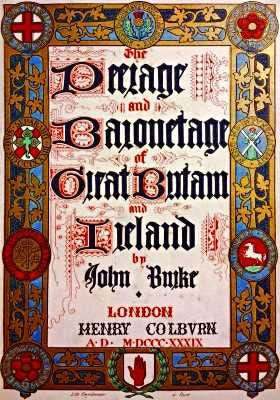
The opening sentence introduces us to Sir Walter of Kellynch-hall as “a man who, for his own amusement, never took up any book but the Baronetage,” a volume carefully identifying the exact rank and estate of minor aristocrats like Sir Walter. He occupies himself by reading, and updating, his own entry in the book, and Austen tells us that “he could read his own history with an interest which never failed.”
Sir Walter’s conceited preoccupation with rank also shapes how he treats his own family members. He has three daughters: Elizabeth, Anne, and Mary. All the father’s hopes rest on Elizabeth. Anne he considers unlikely to make an advantageous marital alliance: “A few years before, Anne Elliot had been a very pretty girl, but her bloom had vanished early; and as even in its height, her father had found little to admire in her [features], … there could be nothing in them now that she was faded and thin, to excite his esteem.”
As for Mary, she has already found a husband that we might consider suitable, but Sir Walter does not. Mary “had merely connected herself with an old country family of respectability and large fortune, and had therefore given all the honour, and received none.” The italics only accentuate Austen’s irony: though at risk of losing Kellynch-hall because of his debts, Sir Walter can see no advantage in marriage to a prosperous husband, however respectable, who bears no rank.
Before wrapping up this introductory post and turning you loose to begin reading, I should return briefly to the middle daughter. Anne Elliot will be our heroine, but her presence in the opening chapter is minimal. She does not appear and is hardly even mentioned; her near invisisibility is itself a comment on social status, since this woman whose qualities we will come to admire escapes notice in her own immediate family circle.
Her father, as we have seen, thinks little of her, rating her even below Mary, who at least has married, however unworthily. But Austen, as narrator, indicates very briefly that Anne’s worth exceeds her father’s low estimation:
Anne, with an elegance of mind and sweetness of character, which must have placed her high with any people of real understanding, was nobody with either father or sister: her word had no weight; her convenience was always to give way; — she was only Anne.
In a mere half-sentence—almost all the space afforded Anne in this opening chapter—Austen tenders her high praise indeed: she possesses “elegance of mind and sweetness of character.” We learn also that her godmother, Lady Russell, has a special fondness for Anne, the only daughter of the three who reminds her of their “sensible and amiable” mother. Nevertheless, in this introductory comment, Austen portrays Anne as only persuadable and never persuasive: “her word had no weight; her convenience was always to give way.” We will want to see how Anne herself grows and develops over the course of the novel.
That should suffice to get us started. I hope that I can … (ahem) … persuade … many of you to read along as Christina and I work through the novel together. We’ll be posting again on Wednesday, June 24, and remember that you can join us for a live conversation on Wednesday, July 1, from 2-3pm Eastern Daylight Time. (For a reminder of the full read-along schedule, see here.)
As always, thanks for reading, and I’ll see you next time for another installment From My Bookshelf.