
A Miracle Book
The Icelandic Peasants of Halldór Laxness

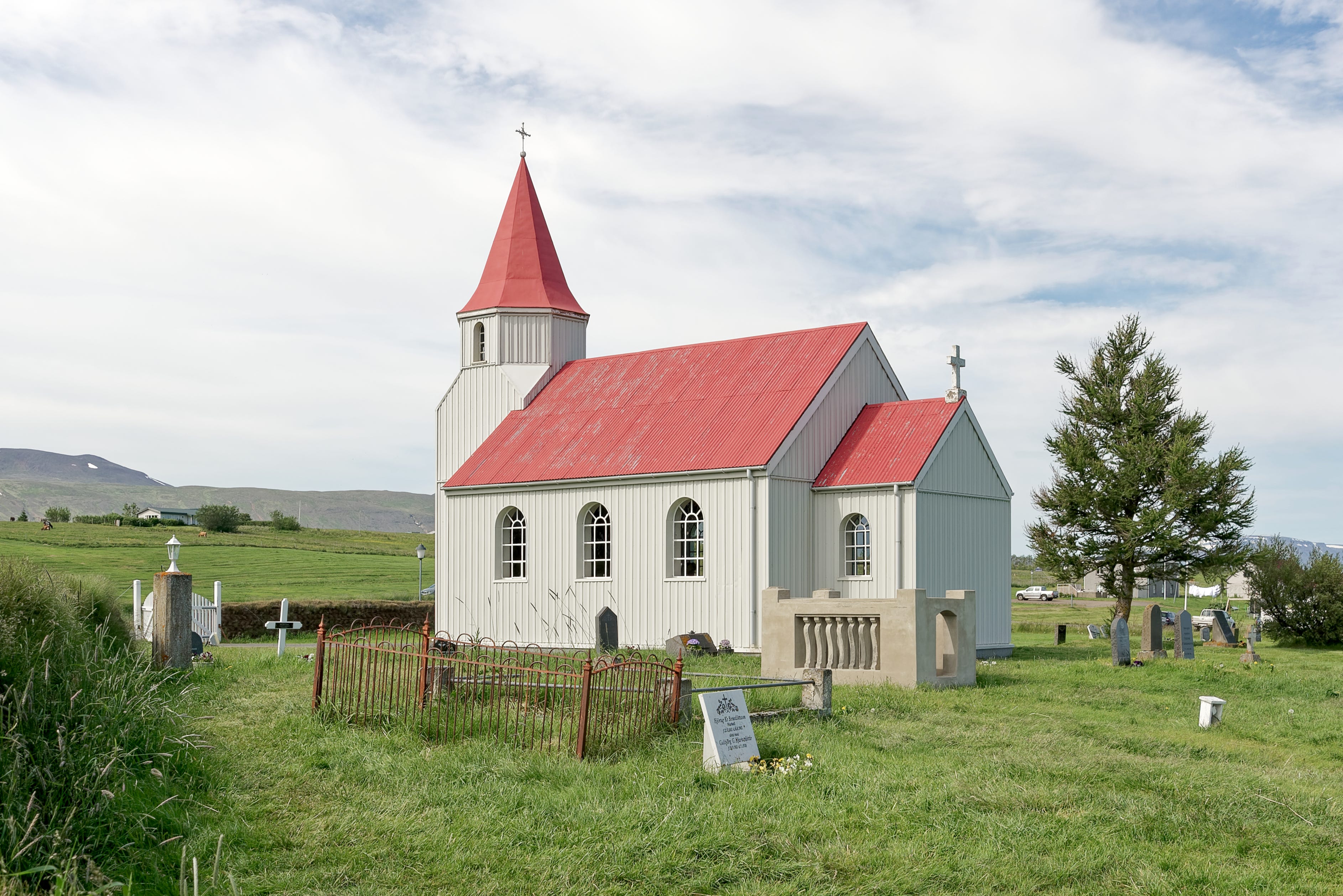

I have read my first Halldór Laxness.
Laxness, who in 1955 became the only Icelandic writer ever to win the Nobel Prize in Literature, has been on my “to read” list for a while, especially his widely praised novel Independent People. But I started with something shorter instead: A Parish Chronicle, recently released by Archipelago Books in a translation by Philip Roughton.
It’s probably a good thing that A Parish Chronicle, one of Laxness’s last novels, is a small book, because I have been traveling and was trying to pound out this post during spare moments in airports or on planes. If it ends up being more disjointed than usual, you’ll know the reason why.
(Incidentally, I will in fact be on the road for most of the next two weeks, so posts here at From My Bookshelf may be somewhat irregular during that time. My travels end on Tuesday, May 19, so after that I should get back to normal.)
The story’s plot is a simple one. It follows a country church in Iceland built, or so the local legend goes, upon the bones of “Iceland’s national hero and chief poet Egill Skallagrímsson.” In 1774, the Danish king, ruler of Iceland, ordered the church’s removal. For over a century, both church and government officials more or less ignored the decree. But in the late 1880s, suddenly they decide that the time has come and the church must be torn down.
Two of the local residents are determined to resist the church’s destruction, a farmer named Ólafur Magnússon and the parish priest’s young maid, Gúðrún Jónsdóttir. Both of them are peasants through and through: dogged, stubborn, conservative, independent. Ólafur “didn’t speak well of people in general but was considered peaceable himself.” He refuses to fence in his fields and reacts in anger when the parish dogs chase after his livestock, but he has a cunning knack for sending his own hounds bounding after any stray unfamiliar sheep. When he confronts the local priest about the proposed church closing, he angrily wields his scythe like a hero from an ancient Icelandic saga.
Ólafur and his family provide Laxness with an opportunity for a humorous digression on the Icelandic character:
[L]ife in Iceland was, as it still is today, all about sheep. For example, when talking about the weather, it was only from the perspective of how it suited the sheep. Good weather was the weather that was good for sheep. A good year was one in which enough grass grew for the sheep. A beautiful landscape in Iceland is one in which there’s good pasturage for sheep.
This tone is typical of Laxness’s attitude toward his characters throughout the book: not uncritical, here even gently mocking, but always affectionate.
Gúðrún, or “Big Gunna,” is another larger-than-life peasant character; she was “considered a unique person in her community both at a young age and ever afterward.” She is “very comely,” which in her context means she “was a heavyset woman and had the physical strength of vigorous men.” She does odd jobs at various farms but never hires herself out for wages, refusing the relation of dependence that would imply:
She was in fact a capitalist because she was never formally employed at any particular farm, but instead worked on her own terms, free of obligation to whomever hired her—what in those days was called a “freewoman.” That title had an air of distinction, even if it may have been imaginary.
If Ólafur seems to have stepped out of an ancient saga, Gúðrún at one point sounds almost like a character from a saint’s life. In a chapter called “The Story of the Precious Bread,” she wanders lost for three days and nights through a thick fog in the mountains, surviving with nothing to eat or drink, even though she is carrying a heavy loaf of bread for the parsonage. When asked why she had eaten none of it to ease her hunger, she answers firmly:
“What you’ve been entrusted with, you’ve been entrusted with,” says the woman.
Question [from the narrator]: “Can one never be too devoted to one’s master?”
The woman asks in return: “Can one ever be faithful to anyone but oneself?”
Those words of independence and self-sufficiency—implying that she has refrained from eating the bread not for the pastor, and not for God, but for the sake of her own integrity—echo throughout the novel.
Despite the protestations of Ólafur and Gúðrún, however, there is little they can do. Quietly, but with an air of bureaucratic inevitability, the church comes down. Its property is inventoried and removed, though a few items—notably an old bell and a silver chalice—go missing.
At this point, the story takes a sudden turn to introduce a new character, Stefán Þorláksson, the illegitimate son of an ash-collector from the capital. Coming to live with his father after his mother’s death, Stefán shows an entrepreneurial bent from a young age. One day, for motives that are unclear—boredom? a desire to see the world?—he runs away. Hungry and exhausted, he ends up at Ólafur’s front door.
The family takes the poor boy in, and he remains for the next twenty years. Eventually, word comes that his father has died. When the authorities arrive to prepare the old man’s body and take stock of his little property, a surprise awaits them: for years, the ash-collector has been saving the coins he received for each load of ashes carted away from somebody’s home. In the process, he has accumulated an impressive hoard. Stefán, his heir, is suddenly wealthy.
With his new fortune, he can give his business instincts free rein. He runs a taxi service, then starts an auto garage. He sells the garage to the city in exchange for a bankrupt model farm. The farm turns out to be located on geothermal springs that provide Reykjavík with its heat. Everything Stefán touches—farm machines, refrigerators, rare first editions, a schnaps named “Black Death”—turns to gold in his hands.
When he dies, Stefán makes a last special bequest in gratitude to Ólafur and his family. Although he had never shown the least interest in Christianity,
Stefán Þorláksson stipulated in his will that the rather large amount of assets he left behind should be used to build a large and good church at Mosfell in Mosfellsdalur, there on the ruins of the old churches that keep the head of Egill Skallagrímsson.
And thus the church rises once again. Even the old bell resurfaces, unearthed from its hiding place in the muck surrounding Ólafur’s farm. So too does the silver chalice, which had been found among Gúðrún’s possessions when she died, anonymous and poor. Laxness ends the book with Gúðrún and her chalice:
No one had known that this destitute old woman had any valuables in her possession until her death, much less how this chalice had come into her hands, and least of all for whom she was keeping it. In fact, this was the woman who had once asked: “Can one ever be faithful to anyone but oneself?” Thirty-five years ago, some old men said that they recognized the object, and that it was the old chalice from Mosfell Church. So ends this miracle book.
A “miracle book,” Laxness calls it. But what is the miracle? Perhaps the rebuilding of the church. But perhaps something else, also. The novel’s very first chapter, introducing the main characters and the threat to the church, ends with this sentence: “[M]any believe that God’s wisdom and long-suffering achieved a certain victory in this matter here in Mosfellsdalur, even if it took some time, and the world might well take notice of this, although there may in fact be something to the viewpoints of those who think differently.” That oddly ambiguous sentence suggests, I think, that the book’s miracle may not be simply God’s victory, but rather the survival of this stubborn race of peasants, the Ólafurs and Gúðrúns, who are perhaps less interested in the church’s real significance than its role as their own local shrine to Egill Skallagrímsson, and who are faithful most of all to their own independence and sense of self-worth.
.jpg)
Laxness does not idolize these peasants. They are ironically represented by the ancient dung heap located on the marsh surrounding Ólafur’s home. It had been “created in antiquity in front of the cowshed door at the east end of the row of buildings [and] continued to mingle its liquid materials with the rest of the farmyard mud, with no clear distinction between them.” Laxness’s characters are coarse and thick-headed, interested mainly in themselves and their farms. He describes them with a journalistic realism that matches the book’s self-description as a “chronicle”—surely a nod to the old medieval chronicles, although the heroes of this chronicle are not kings and knights but rather a farmer and a poor maid.
One passage in particular seems to sum up Laxness’s attitude towards these countrymen of his:
It has been argued that Icelanders are swayed little by rational arguments, and hardly economic ones, either, yet even less by religious rationale, but solve their problems by splitting hairs and arguing over irrelevant trifles, and become terrified and dumbstruck when it comes to the heart of the matter. On the other hand, they take on herculean tasks to oblige their friends and relatives, and were it not so, Iceland’s rural communities would have collapsed many centuries ago. Yet there is one other type of reasoning that Icelanders willingly submit to as a last resort, and that is humor, even of the most imbecilic sort.
Foolish and irrational, rising to the occasion when help is required, and with an ability to laugh at life’s absurdity—these are the “independent people” that Laxness lovingly portrays, warts and all, in A Parish Chronicle.
As always, thanks for reading—I hope this did not suffer too badly from the circumstances of its composition!—and I will see you next time for another installment From My Bookshelf.
And . . . another book for the ever-growing Amazon list . . . Thanks for this most interesting review.
Thank you for reminding me of Laxness. I read Independent People many years ago -- so many that I must confess that I now remember very little of the story -- and absolutely adored it. A Parish Chronicle sounds very good -- yet another to add to my "to be read" stack!