
On Serendipitous Reading
How One Book Leads to Another


Instead of writing about a specific book (though I will mention several before I’m finished), today I want to write about a certain way of reading, one I call “serendipitous reading.”
I wish I could take credit for the label, but I did not coin the phrase. I saw it here on Substack, maybe a year and a half ago, and immediately appropriated it. Alas, I no longer know where I found it and therefore cannot give credit as I would like; if you happen to remember seeing it yourself, or even (better yet!) were the person who came up with the phrase, let me know in the comments section below.
Several years ago, I helped update the curriculum of a “Global Studies” major at the small college where I teach. Along with another colleague, I felt strongly that the major’s core ought to include a required humanities course. So the two of us succeeded in adding an “Introduction to Global Humanities” to the course catalog and making it a requirement for our majors.
Creating a course number and title is one thing; actually designing and teaching the course is something else altogether. But this spring—my co-conspirator having since left to teach elsewhere—I find myself having to teach the new course for the first time.
It is a somewhat daunting task. It’s not as though “Global Humanities” is an established field. It has no defined canon, characteristic subfields, or even a standard methodology or familiar set of questions that it pursues. I’m making it up as I go.
And the material one could potentially cover is vast! Any literature, history, philosophy, theology, language, art, music, political thought, et cetera, et cetera, from all over the world is potentially fair game. Most of it, needless to say, well outside my own expertise.
What to do?
Serendipitous Reading
In designing the course, I had one thing to go on—not any specific content, but rather a vague sense of what I hoped the class might accomplish for, and in, the students. I wanted them to share a certain experience, one I have had in my own professional career and have gradually sought to cultivate more deliberately: that of stepping outside the familiar Anglo-American canon, inhabiting a foreign cultural space, and trying, within the limits posed by available time and resources, to develop a partial understanding of what it might be like to look out on the world from within that space, with its own history, inherited literary tradition, religious experience, and the like.
To accomplish that, I wanted my students to practice a certain manner of reading, apparently dilettantish but not entirely undirected. I wanted them to pay attention to what they were reading, probing it for clues about what to read next, letting a historian guide them to a novel that might then guide them toward a musician or religious figure in turn. I did not want them to worry about attempting a systematic approach to their subject, because coming to know a people, country, or culture is not quite the same experience as mastering a particular body of knowledge. I wanted them, in short, to practice serendipitous reading.
In the course syllabus, I attempted to give them a description of what this would be like:
My goal in this course is for students to acquire facility in learning about global diversity by moving back and forth across disciplinary boundaries through a practice I call “serendipitous reading.” (The phrase is not my own, but unfortunately I no longer remember where I first came across it, so I cannot give credit for it.) The world is a vast, rich, enormously diverse place, and each individual culture within it is also tremendously complex. Understanding another culture deeply can take years of study along with immersion in it and personal relationships with its members. Very few of us have time—now, or ever—to explore even a single foreign culture in that kind of detail, let alone many of them. Nevertheless, we benefit from some understanding of other cultures for a host of reasons: we become more humble; we gain deeper insight into our own culture; we grow to appreciate the richness of God’s kingdom; and we increase our understanding of the world we live in and our ability to navigate its challenges successfully.
What to do, then? My conviction is that great progress can be made through the conscious, deliberate practice of serendipitous reading, and that students can develop this practice and make it an ongoing part of their lives. In serendipitous reading, we allow ourselves to be led from one source to another, keeping our eyes always open for new books, topics, and subjects of interest, letting connections among ideas emerge organically, and thus building up gradually, over time, a “picture” of the country or culture we are studying. That picture will be imperfect and therefore dynamic, changing as we learn more; as we learn, we find ourselves continually adjusting the focus, as it were, trying—to switch metaphors—to see more clearly as we discover new pieces of the jigsaw puzzle we’re assembling.
As I have been teaching the course, I have found myself recurring to two metaphors that help describe what we are doing. The first is that image of the picture coming into focus, or the puzzle being gradually assembled. Imagine putting together an enormous jigsaw puzzle, with thousands and thousands of pieces. At first, you would feel rather lost, and no individual piece would carry much meaning. But as you made slow progress, bits and pieces would begin to make sense. You would suddenly realize what was going on in one section of the puzzle, and then another, and you would try to figure out how those different sections related to each other as parts of the whole. But you would also experience surprises. Those pieces you thought were fabric on a woman’s dress might turn out to be a store awning, or a blanket hung out to dry; that little scene you thought was near the center of the puzzle might turn out instead to be way off to one side, out on the margins. Gradually, you might develop a sense of the picture as a whole.
This puzzle metaphor is quite good, I think, at capturing what it feels like to plunge into a different culture, where nothing makes sense at first and one struggles to pit the pieces together. But it misleads, I think, in the implication that there is one single picture waiting to emerge. Just fit the pieces together correctly—and there is only one right way to do that—and you will have discovered what you are looking for. But of course a culture isn’t quite like that. It has certain characteristics, to be sure, but different people will give somewhat different interpretations of how they come together to form a whole. America, for example, is commonly described as individualistic. But just how individualistic it is, or how that individualism is balanced against our tendency to form churches and parent-teacher associations and Little Leagues, or how it differs from one region of the country to another—there simply isn’t any one correct answer to these questions, no one picture waiting to emerge if only we fit the pieces together correctly.
I have thus found myself drawn to a second metaphor: that of gradually coming to know another person. When you meet someone for the first time, you have no idea of her background: her parents or siblings, the places she has lived, her favorite subjects in school, what music she listens to, her hobbies, her favorite foods, where she goes to church, her hopes and dreams for the future. As you get to know each other, bits and pieces of this gradually emerge. In the process, you come to know your friend. But people are complicated, and your friend’s personality has many facets: some days she is happy and carefree, on others thoughtful and somber; she can be proud of her achievements one moment and ashamed of her failures the next; she might often be timid or shy but suddenly flare up in righteous indignation at some slight or injustice. You get to know your friend better and better—but you never fully know her, once and for all.
In my global humanities class, I want serendipitous reading to work like that process of getting to know a friend, except that in this case the “friend” is another country or culture. As we move from one source to another, with a sense of where we hope to end up but ready to try any number of paths for getting there, we gradually make progress. Slowly. Unpredictably. Serendipitously.
For example…
What does this look like in practice? I have organized my course around three mini-units on three different countries: Poland, India, and Argentina. (At the end of the semester, each student will put together a fourth short unit on a country of his or her choosing.) I chose the countries somewhat randomly, with only three general criteria in mind: (a) I wanted countries from different regions of the world; (b) I wanted to be sure we would find adequate resources for studying each of them; and (c) none of them was to be a country about which I already knew very much, so that I would start out in more or less the same situation as the students. I knew a bit about Poland, but not a great deal; less about India; and probably least of all about Argentina.
I then devoted four weeks of the semester to each of these countries. For the first three weeks, I selected a set of readings, drawing primarily upon books with which I was (serendipitously) unfamiliar. As we read, the students must generate their own suggestions for things they would like to read next. Then, to choose the readings for week four, we vote from among their selections, so that the final readings in each unit emerge from their own process of serendipitous reading. (I have also required them to do a very small amount of language study: 20 minutes per week on Duolingo, first for four weeks of Polish, then Hindi, then Spanish.)
As an illustration of how this works, let me offer a brief description of our first unit, on Poland, which we have by now finished.
Week One
I like to start things off with a bit of history, because it helps orient us for everything else, and I know that however little I know about these countries, my students know even less. (Barring some strange coincidence—one young woman, it turns out, happens to have spent several years growing up in India!) Obviously, we can only scratch the surface. But you have to start somewhere, and every beginning will always feel inadequate.
So I ordered A Concise History of Poland by Jerzy Lukowski and Hubert Zawadzki, published by Cambridge University Press. When I need a quick historical introduction and have no prior sense of where to begin, the Cambridge “Concise Histories” and Oxford “Very Short Introductions” are my go-to starting-points. At about 500 pages, this particular “concise” history was more than we could read in a week, so we started in medias res, beginning in the mid-nineteenth century and reading the second half of the volume, on the theory that this was most likely to help my students understand contemporary Poland and its role in Europe.

The experience was, to be sure, something of a blur: many unfamiliar—and to the students, even with the help of Duolingo, often unpronounceable—Polish names, places, battles, and political parties. Nevertheless, in reading about a long stretch of time during which Poland did not even exist as an independent country, we came away with a lively sense of Poland’s historic linguistic and cultural diversity, with different regions of the country shaped by Russian, Lithuanian, Ukrainian, Austrian, and German influences, but all the while retaining a proud sense of Polishness based in large part on language and the Catholic faith. We learned of the important role played by Polish Jews until they were largely exterminated in the Second World War. We learned of Poland’s short-lived independence early in the 20th century, its domination by the Soviet Union, and then its reemergence following the Cold War. And the book’s many descriptions of historical and cultural figures, along with its notes and bibliography, made it a fruitful place to search for further reading.
Week Two
I wanted to follow the history with something literary, preferably contemporary. So I went to my favorite publisher for world literature in English translation, Archipelago Books, and I browsed their selection of translations from Polish. I found a number of promising titles, but most of them were too long. One fairly recent novel, however, came in under 200 pages and appeared to have political implications: Magdalena Tulli’s Flaw, translated by Bill Johnston. I had my second book.
Flaw (which I mentioned briefly in this earlier post) is set in the town square of an unidentified Polish village. One day a large crowd of refugees shows up, displaced by political disturbances elsewhere. The town’s residents, whose daily routines are predictable if devoid of any great significance, quickly find this influx of unwanted people troubling as their lives are disrupted in various ways. Eventually they herd all the new arrivals into an empty cinema and confine them there. The novel’s structure is quite experimental: the role of the omniscient narrator, who may be attempting to stage all of this as a theatrical production that itself is disrupted, remains rather ambiguous.

Apart from a somewhat disappointing ending, Flaw was an interesting novel, albeit one that did not directly reveal as much about Polish life or culture as I had hoped it might. Serendipitous reading has its risks as well as its rewards. Nevertheless, it provided an opportunity for us to wonder whether the townspeople’s rather empty, bourgeois lives reflected the challenges and frustrations of emerging from communist rule into a market economy; or what the book might have to say about Poland’s reaction to contemporary migration flows; or, alternatively, to what extent it might be a commentary on the treatment of Jews during the Holocaust. In all these ways, it picked up on and extended themes we had encountered in reading about Poland’s history.
Week Three
What to read for our third book? One of the few things I did know about Poland even before teaching the unit was the importance of Catholicism in Polish culture; having become interested in politics during the 1980’s, I remembered the important role played by Pope John Paul II as not only a spiritual leader but also a great Polish national hero and central figure in the collapse of Soviet communism. Perhaps I could find something related to Polish Catholicism?
Luck was with me, because as I browsed on Amazon, I almost immediately discovered a book by one Jerzy Kluger: The Pope and I: How the Lifelong Friendship Between a Polish Jew and Pope John Paul II Advanced the Cause of Jewish-Christian Relations. Though a popular rather than a scholarly book, it looked rather promising, a mixture of history, culture, and religion across much of the 20th century and into the 21st. I decided to roll the dice.
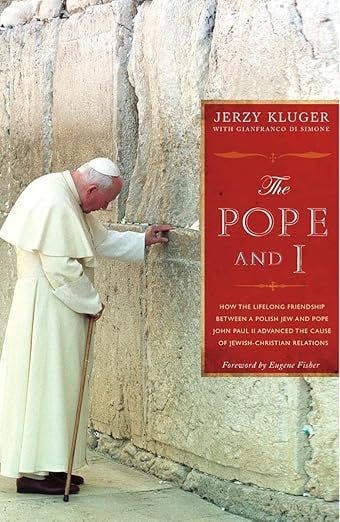
And am glad that I did, because it turned out to be quite a delightful memoir. For my purposes, it was extremely useful, because it shed light on so many different topics without going too deep into any of them. We learned more about Polish life after the First World War, when the country became independent; about both Judaism and Catholicism in Poland; about World War II and the Holocaust (in which much of Kluger’s family perished); about Poland during the Cold War; and about the influence of Solidarity and the Catholic Church in ending Soviet tyranny. And all of this was packaged in a moving story of a close and lasting friendship between a Catholic and a Jew. A serendipitous selection indeed.
Week Four
And what about week four, for which I had not selected the readings in advance? I required all students to generate two suggestions for further study, and then to vote for their top three choices from the list of recommendations, with just a bit of curating and cautious advice from me. (Much though I would like to read The Peasants by Nobel Prize-winning author Władysław Reymont, for example, I ventured the opinion that an almost 1000-page novel might be more than we wanted to tackle.) I also permitted non-textual recommendations such as music, film, or art.
So what winners emerged? There were three.
One of the students discovered a 2020 Deutsche Welle documentary on YouTube, “Jewish Life in Poland,” focusing on the continued practice of Judaism in Poland today. Without downplaying continued antisemitism and the challenges that Jews confront, it optimistically reminded us that Judaism has not been totally extinguished in Poland. The rabbi who features prominently in the documentary, Michael Shudrich, is a pretty impressive fellow.
For our second selection, the students actually chose one of my own recommendations: Henryk Górecki’s third symphony, the three-movement Symphony of Sorrowful Songs (which was a surprise musical hit when I was in graduate school). The symphony actually linked up pretty well with some of the historical and religous themes we had already encountered. While Górecki’s “holy minimalism” was not to all of the students’ taste, it was interesting to include a source very different from the texts on which we usually focused.
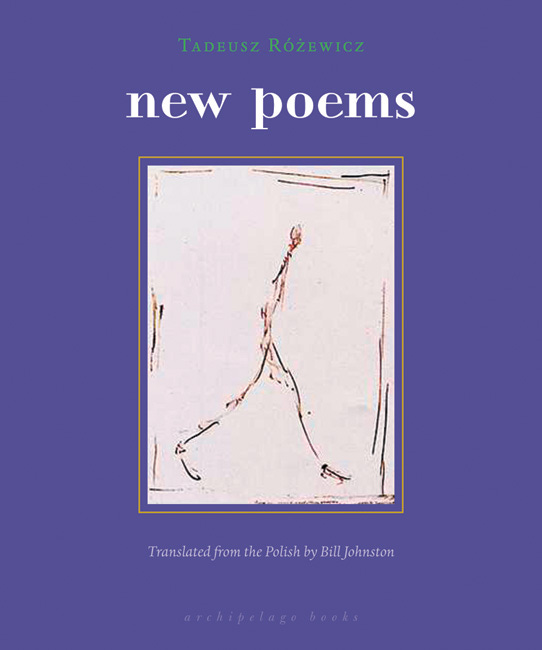
The final winner, also carrying us into a different genre, had been suggested by a student whom I had converted into an Archipelago Books fan. She found a volume of poetry, new poems, by Tadeusz Rózewicz (1921-2014). I somewhat randomly—not to say serendipitously—flipped through the book and selected an assortment of poems that caught my eye. Though occasionally hard to decipher, many of them contained historical, political, literary, philosophical, or religious allusions, challenging us to see how many we could understand at the end of four weeks studying the country.
So there you have it: a four-week mini-unit of serendipitous reading about Poland. And of course if any of the students had their appetite whetted and would like to read more, they have a list of further suggestions they could sample. But the real point, of course, is not necessarily for them to become fascinated by Poland; rather, I hope they will go away from the class with a sense of how they might begin reading if they ever want to get to know another country or culture—any country or culture—the way they might get to know a new friend.
Obviously, the practice of serendipitous reading can be extended well beyond the “global humanities” context, as a way of exploring any subject—not simply haphazardly, always with a goal in mind, but nonetheless open to surprises, new directions, and unexpected discoveries.
I hope that this attempt to flesh out the idea of serendipitous reading has perhaps sparked ideas of your own. If anything in it has resonated with you, I would love to hear about it in the comments section below.
As always, thanks for reading, and I’ll see you next time for another installment From My Bookshelf.
You reminded me of an article published in the New York Times Magazine last June 22. The article in the on=line version carried the title "A.I. Is Poised to Rewrite History. Literally." We're not able to render in bold or italics words in Substack comments but I was able to change a pivotal sentence to all caps (a poor substitute). As a person who has only visited a library once in the last decade I did recognize with nostalgia the serendipity described in this excerpt, looking for one book and finding another of more interest and value:
"How might A.I. change the way history is written and understood? To answer that question, it’s useful to think about L.L.M.s as merely the latest in a long series of shifts in the organizing of human knowledge. At least since the third century B.C., when Callimachus wrote his “Pinakes,” a series of books (now lost) cataloging the holdings of the famous library (now lost) in Alexandria, humanity has devised increasingly sophisticated systems for navigating pools of information too large for any one individual to take in.
Such systems inevitably have a double edge when it comes to scholarly research, a task where “efficiency” always risks being synonymous with cutting corners. The printed index in books, a device dating back at least to the year 1467, allowed scholars to find relevant material without reading each tome in full. From the perspective of human knowledge, was that a step toward utopia or dystopia? Even now, 558 years later, who’s to say? INNOVATIONS THAT CULTIVATE SERENDIPITY — SUCH AS THE DEWEY DECIMAL SYSTEM, BY WHOSE GRACES A TRIP INTO THE STACKS FOR ONE BOOK OFTEN LEADS TO A DIFFERENT, MORE SALIENT DISCOVERY — MUST, ALMOST BY DEFINITION, BE PLAGUED BY ARBITRARINESS. Classify a book about the Mariposa Battalion with Brands’s “The Age of Gold” and other gold-rush titles (979.404), and it will acquire a very different set of neighbors than if it’s classified as a book about the Battalion’s victims (“Native populations, multiple tribes,” 973.0497)."
https://www.nytimes.com/2025/06/16/magazine/ai-history-historians-scholarship.html
What an interesting way to describe that kind of reading. I do that all the time, trying to find out more about the subject I've been reading about. Though not as thoroughly as you because I read for my own pleasure.
But I love that word, serendipity, it is not only beautiful but expresses something that you can hardly express in any other way. My brother even named his boat that way.